

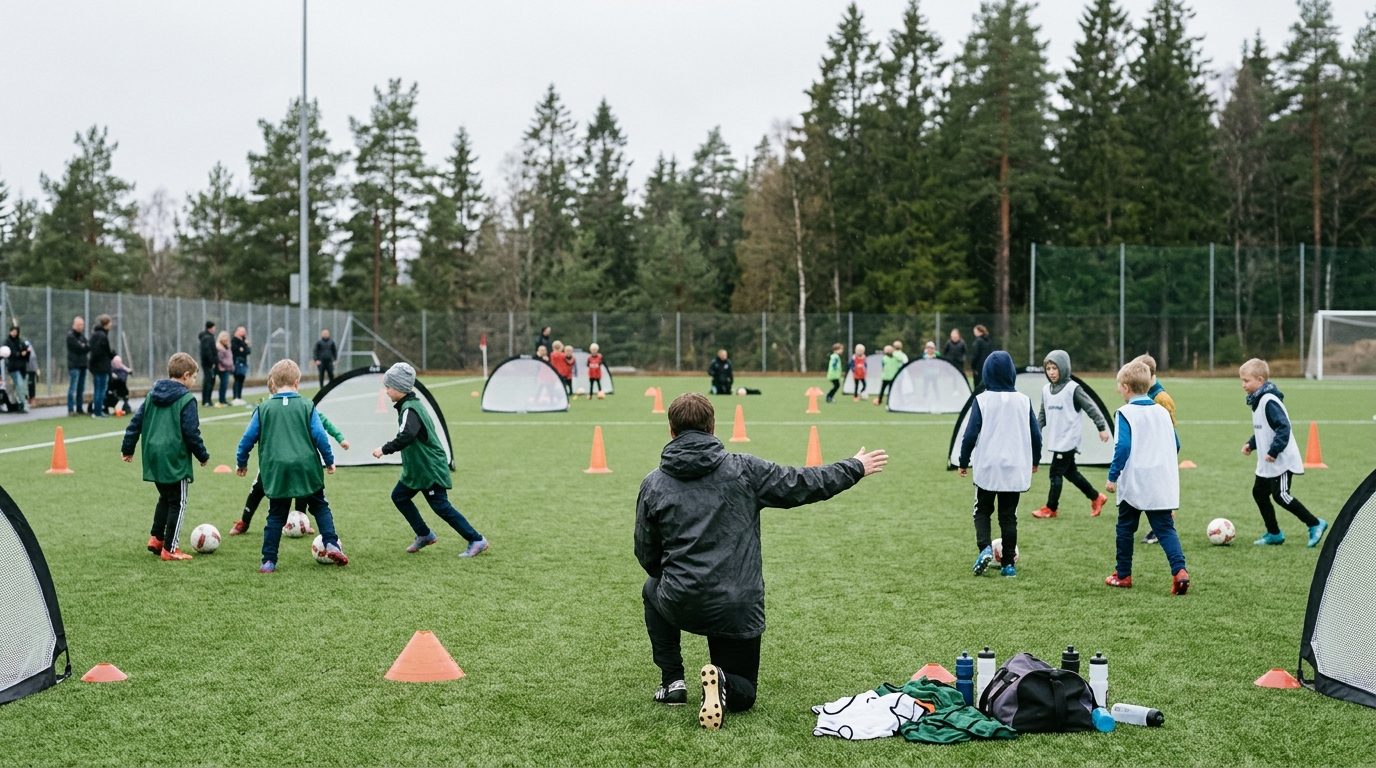
Differentiation in training: how to give every child the right level of challenge
In a group of 20 children there are always some who are bored and some who struggle to keep up. Differentiation is about adapting drills and opposition so that every child gets a challenge they can just about master – without splitting the team into A and B.
Everyone is there, but not everyone gets the same out of the session
You know the scene: 18 eight-year-olds on the artificial turf on a Tuesday. Three of them have played football since they could walk and want more tempo. Four started this autumn and lose the ball every time they get it. You start an ordinary passing drill, and within five minutes the strongest kids are messing about while the newest ones stand there staring at the ground.
There is nothing wrong with the children. The problem is a drill that only suits a third of the group. This is why the Norwegian Football Federation highlights differentiation as one of the core principles of children's football, side by side with equal matches. Every child should get challenges tailored to them – in the same team, at the same training session.
What differentiation is, and what it is not
Differentiation means adapting content and opposition so that each child meets challenges they can master with a bit of effort. Not so easy that it gets boring, and not so hard that it feels hopeless.
It does not mean splitting the team into an A team and a B team. Fixed ability groups in children's football almost always produce the same result: the kids on the "weak" team quickly realise where they have been placed, parents react, and some quit. And the children who are good in February are not necessarily the ones who are good in October. Kids develop in fits and starts, and what you are really seeing when you rank eight-year-olds is often birth month and how long they have been playing.
So the goal is flexible differentiation: groups change from drill to drill and from week to week, and everyone knows they belong to the same team.
Four things you can try at your very next session
- Levels within the same drill. Let the children choose how far from goal they shoot from, or whether to feint before finishing. Kids are surprisingly good at picking a level that suits them – and they often choose a harder one when it is voluntary.
- Conditions for individual players. In small-sided games, the player who dominates can be limited to two touches, have to score with their weaker foot, or have to pass to the least experienced teammate before they are allowed to shoot. Everyone else plays freely.
- Several pitches at once. Set up two or three 3v3 pitches and distribute the players so the games are even. Rotate after each game, for example the winning team moves up one pitch.
- Adjust the opposition, not just the drill. A beginner dribbling against a passive defender learns a lot. The same beginner against the fastest player on the team only learns how to lose the ball.
Example: one drill, three levels
Say you are working on turns. Every child gets a ball and a small square.
- Level 1: dribble to the cone, turn, dribble back. No defender.
- Level 2: the same, but a teammate follows passively and "steals" the ball if you are too slow.
- Level 3: 1v1 under full pressure, where you must turn at least once before you can score.
The children choose for themselves, and you can quietly suggest to some of them that they try the level above. Everyone works on the same theme, everyone is on the same pitch, and nobody is pigeonholed.
Change groups often, and say why
When you split into ability groups for a drill, do it quickly and informally. "You four take that pitch" is better than reading out lists. And mix the groups again for the next drill. Children spot patterns fast: if the same five always end up together, you have in effect created an A team whatever you call it.
Feel free to explain to the whole group what you are doing: "Today I am splitting you up so everyone gets games that are a bit hard. That is how you get better." And they feel safer when they know it is not about who is best.
Three traps to avoid
- Only differentiating upwards. Those who struggle need just as much adaptation – often more time on the ball and less pressure.
- Letting parents decide. Parents of the strongest players often want a "separate group". Hold firm that the whole team trains together, and that you adapt within the session.
- Believing that identical means fair. Giving everyone the same drill at the same pace is not fair. Fair is everyone having something to reach for.
Equal matches start at training
Teams that differentiate well in training also have an easier time on match day. Coaches who know their players' levels pick more even sides for 5-a-side and 7-a-side matches, let everyone try different roles, and avoid the same kids always sitting on the bench when things get tight.
When you use MyTeams, you can store a simple level rating for each player and let the app suggest balanced teams with fair playing time – so you can spend your time on the touchline on what actually matters: seeing every single child.

