

Football Coach: Everything You Need to Know to Succeed with Your Team
Being a football coach at youth level involves far more than planning training sessions. Here you get concrete guidance on playing time, communication with parents, and how to build a safe environment where players develop at their own pace.
Playing Time: NFF Rules and How to Distribute Minutes
Norges Fotballforbund (the Norwegian Football Federation) has clear guidelines for playing time at youth level. For ages 6-12, all players should receive approximately equal playing time in each match. This doesn't mean second-by-second measurement, but a conscious distribution where every child experiences the different phases of the game.
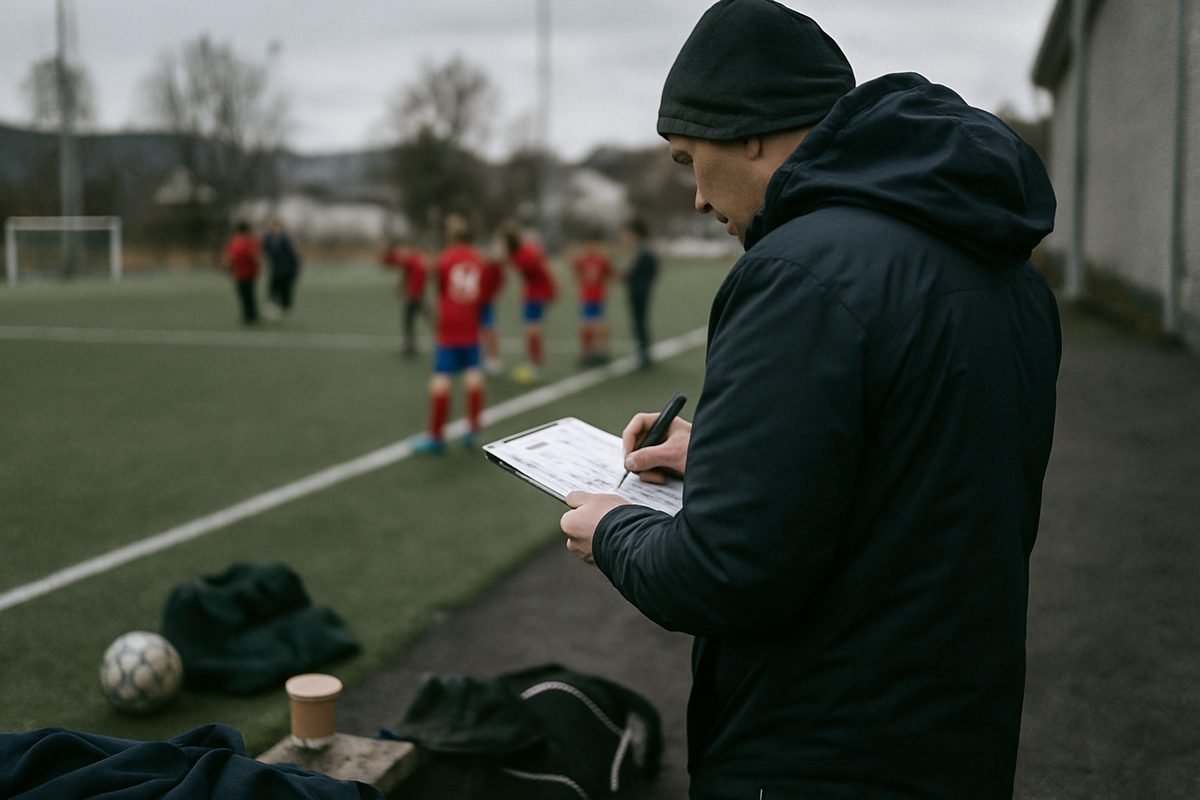
In practice, you can create a simple rotation plan before the match: divide players into groups that substitute simultaneously, and rotate every 10-12 minutes in a 2x25 minute game. Write down who has played where, so that over a season you avoid some players always standing in goal or at fullback. For ages 13-19, the rules allow more variation, but the main principle of fair distribution still applies.
A concrete measure: brief parents before the season starts about playing time rules, and explain how you intend to rotate. This prevents misunderstandings when someone is on the bench in the final minutes of a tight match.
Training Planning That Actually Works
A good training session has three components: warm-up with ball, main exercise with many ball touches, and finish with a game or play. For 8-year-olds, this might mean 10 minutes of tag with ball, 20 minutes of one-on-one duels in small squares, and 20 minutes of 4v4. For 15-year-olds, it could be 15 minutes of passing patterns, 30 minutes of positional play, and 20 minutes of 8v8.
The most important thing is adaptation to skill level: if half the players fail in an exercise, make it simpler. If everyone succeeds with one touch, add an opponent. Training sessions where everyone masters something but must stretch themselves provide the most development.
Remember practically: have a plan B for bad weather (indoor exercises without long shots), and a plan for when numbers are low (everyone-against-everyone games instead of team exercises). Write down what worked – next season you'll be there again.
Communication with Parents: Clear Agreements from Day One
Hold a parents' meeting before the season starts where you review expectations: what you as coach are responsible for, what parents should contribute (drinks, transport, match duty), and what is not OK (coaching from the sidelines, criticism of referees).
Be concrete about how you communicate: create a shared chat for practical information (match venue, training time), but agree that feedback on players is handled face-to-face or in separate messages. A message in the group chat saying "Marius should have played more midfield" creates unnecessary noise.
When a parent contacts you about playing time or team selection, listen first. Then explain your assessments concretely: "Emma is working well in training, and I can see she's becoming more confident. Right now we're practising turning with the ball a lot, which will help her in matches." Avoid comparisons with other players.
Safe Environment: What You Must Know About Player Protection
NFF requires police clearance certificates for all coaches, and you must complete a basic course in player protection. This isn't bureaucracy – it's about recognising signs of distress and knowing what to do.
Concretely, this means: observe who always arrives alone and who stands outside in the changing room. Talk to players who suddenly change behaviour. Have a routine for changing rooms – for younger teams, an adult is present; for older teams, you knock and announce before entering.
Also be clear about what isn't accepted: bullying, exclusion, derogatory comments about mistakes. Stop it when it happens, talk to those involved, and inform parents if it recurs. A team where everyone feels included performs better than a team with high competence and poor chemistry.
Development Over Results: How to Measure Progress
For children under 12, the result in one match says little about development. Instead, notice whether players dare to try new things, whether they communicate more on the pitch than two months ago, whether they solve situations they couldn't manage before.
Create simple goals players can see themselves: "Today we'll try to turn with the ball five times each." "This month we're practising calling teammates' names before we pass." When players notice their own progress, motivation grows.
For older youth, you can set goals together that combine performance and development: "We want to keep clean sheets in three matches" alongside "all defenders should become more confident with their left foot." Results come as a consequence of development, not the reverse.
Tools That Save Time
Many coaches spend unnecessarily many hours on administration. An app like MyTeams gathers match schedules, training attendance, and parent communication in one place, so you don't have to keep track across four different chats and spreadsheets.
But regardless of tools: the most important thing is structure. Decide one day per week when you plan the following week's training sessions. Decide one channel for practical information. Write down the rotation plan before the match and attach it to the equipment bag.
Your Role as Coach
You're not there to create elite footballers – the vast majority quit before they turn 20. You're there to give players mastery, friendship, and love for the game. That means training sessions where they get many ball touches, matches where everyone gets playing time, and an environment where they dare to fail.
They will remember whether you were fair, whether you saw them, and whether you made them want to come back next week. Everything else is details.

