

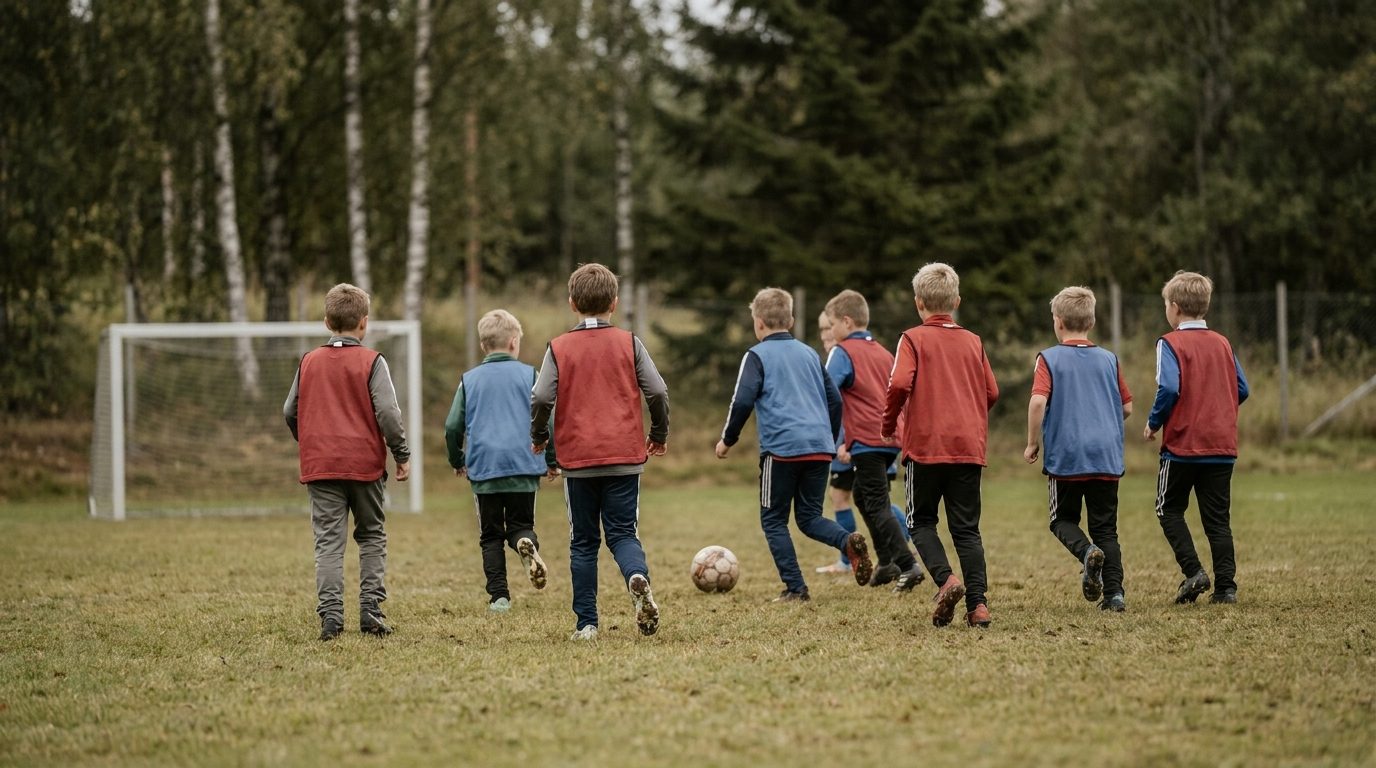
Balanced matches: why 12–0 helps neither team
Nobody learns anything from winning 12–0, and nobody enjoys losing it. Balanced matches are a learning principle, not a fairness principle. Here is what to do before the season, in the handshake with the other coach, and in the middle of a game that has gone lopsided.
The game that was over after ten minutes
There is something particular about a match that collapses early. Ten minutes in it is 4–0, and everyone on the pitch knows how the rest will go. The team in front starts getting sloppy and trying tricks. The team behind stops asking for the ball. Two teams who came to play football are really just waiting for the final whistle.
Afterwards we tend to discuss the score as if it says something about quality. It rarely does. A 12–0 result mostly tells you these two teams should not have met — and that is something we as coaches can actually do something about.
What balanced matches are really about
Balance is not a fairness principle, it is a learning principle. Children develop best when the opposition is roughly at their own level: if the game is too easy, you stop making an effort. If it is too hard, you stop trying.
You recognise a balanced match by something other than the scoreline:
- Both teams create chances, and both keepers have something to do.
- Players dare to take the ball forward, because losing it does not decide the game.
- The least experienced still ask for the ball at 0–2.
- Nobody is checking the clock before the second half.
The most important decision happens before the season
The best work you do for balance happens on the registration form. Most regional associations let you enter teams at different levels, and most of us get it wrong in one of two directions: we enter too high because it feels ambitious, or too low because we want the kids to win.
Enter the team you actually have today — not the one you hope to have next spring. And use your right to adjust: nearly every association allows teams to move between levels at midseason, and there is no shame in asking.
If your club has several teams in the same age group, follow the club's sporting plan. In children's football most associations recommend evenly matched teams rather than fixed A and B squads all year — differentiation belongs in training and in the choice of division, not in the same children always ending up in the same pile.
Five moves when it goes lopsided anyway
Sometimes it goes wrong regardless. Then your job is to rescue the match, not to protect the result.
- Move your strongest players back, not off. Benching your best player feels like a punishment. Putting them in defence or in goal gives the team something to work at without anyone losing playing time.
- Give a task instead of a brake. "Don't score" is a poor message to an eight-year-old. "Everyone has to touch the ball before we shoot" carries the same intention, wrapped up as an exercise.
- Lend them a player or two. Children find this completely unproblematic if it happens early in the match and without drama. It only gets awkward if you wait until 0–8.
- Play with uneven numbers. Five against six is fine when both coaches agree. Nobody in that age group cares what the rulebook says.
- Give the most playing time to those who play least. A lopsided match is the safest moment for the players who usually get the least — whether you are ahead or behind.
Thirty seconds with the other coach
The simplest and most underrated move is the conversation before kick-off. Walk over, shake hands and say something like: "We've got a couple of quite new players today — is it okay if we adjust along the way if it gets very uneven?"
Almost everyone says yes. The point is not the agreement, but that the door is open: when it is 0–5 after twenty minutes, nobody loses face by suggesting a swapped player or uneven numbers.
And what do you tell the players?
After a crushing win: do not celebrate the numbers. Talk about the two times the team played out of pressure, and leave the rest. When a coach at Solsiden IL won 11–0 and only talked about the passes in the build-up, the players noticed — and they stopped counting goals.
After a heavy defeat: skip the result entirely. "We're not going to talk about the score. We're going to talk about the three times we managed to play out from the back." Children copy what the adults care about. If you care about goal difference, so will they.
Knowing your group well enough
All of this assumes you know who you have with you: who is new, who has played little lately, and who can be moved back without minding it. That is a lot to hold in your head on a busy Saturday.
In MyTeams the skill level and playing time sit on each player, and the squad selection suggests line-ups that are balanced — both within your own group and against the opponent you are actually facing. Then balance becomes something you plan for, rather than something you hope for.

